
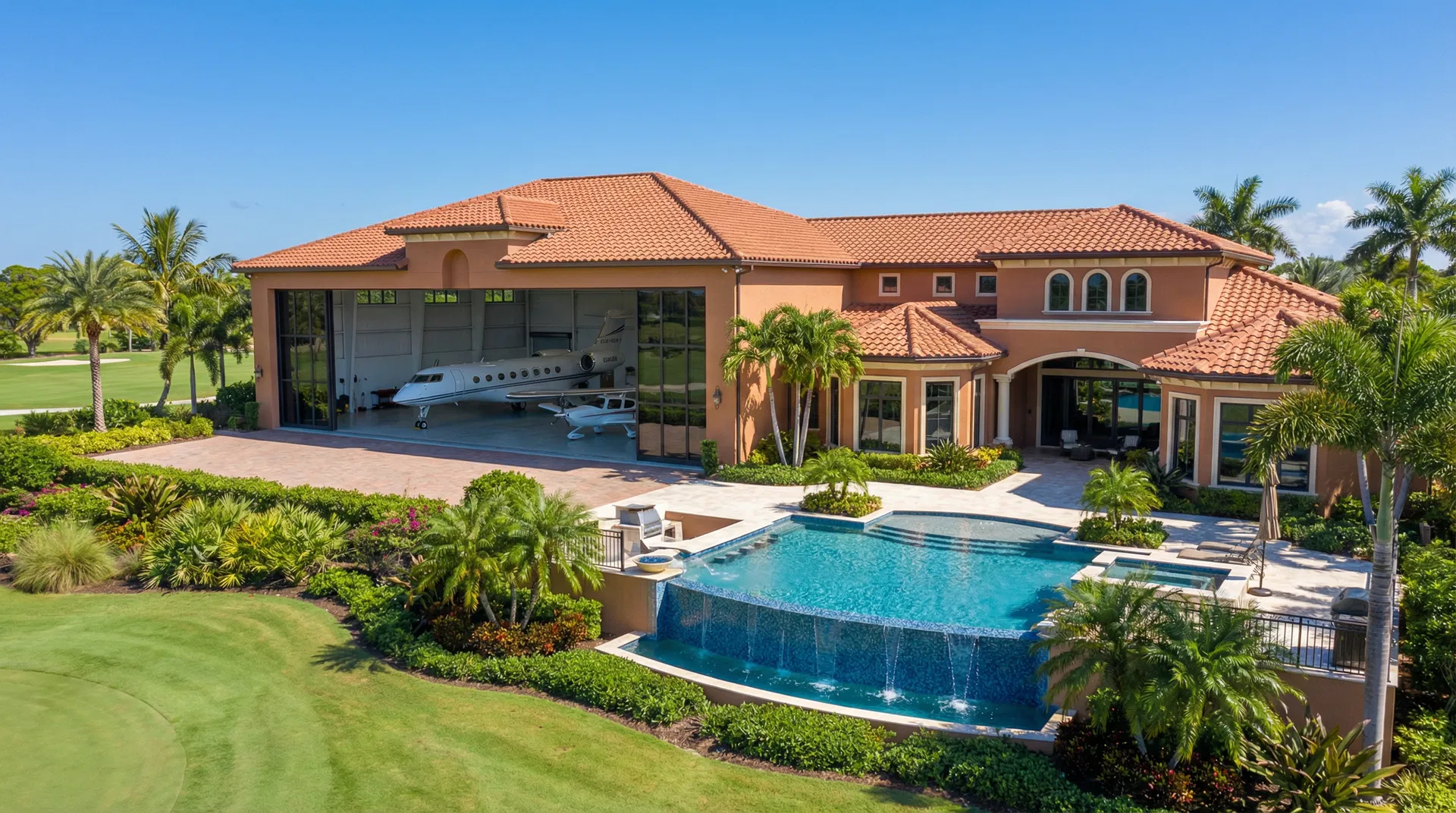
From the 30% price premium documented by Realtor.com to the near-zero turnover rates at established airparks, the investment case for hangar homes is built on data that conventional luxury real estate simply cannot match.
When evaluating real estate investments, the fundamental question is always the same: what creates and sustains value? For conventional luxury properties, the answer involves location, amenities, finishes, and market conditions. For aviation real estate, there is an additional factor that no amount of renovation or repositioning can replicate: the runway.
The runway is the moat. It is the irreplaceable infrastructure that defines the community, creates the scarcity, and drives the premium. And the data on that premium is unambiguous.
The Price Premium: 30% Above Comparable Properties
Realtor.com's economic research team analyzed home listings across the United States and found that homes associated with airparks were priced at a 30% premium to other listings, after controlling for home size and location. This is not a soft premium based on subjective lifestyle appeal — it is a hard, measurable, statistically controlled price differential that persists across market cycles.
The mechanism is straightforward: the supply of airpark properties is structurally limited. You cannot add runway access to an existing neighborhood. The Living With Your Plane Association estimates there are only 426 residential airparks in the entire United States, with Florida having approximately 52. Against a population of more than 500,000 active private pilots, this supply is dramatically insufficient.
The Appraisal Premium in Practice
AV8 Realty's published case study documents a Florida airpark property that was appraised at or below its original purchase price by a generalist appraiser — and then appraised at nearly double the original purchase price by a specialist familiar with aviation real estate comparables. The difference was not the property. It was the appraiser's understanding of what runway access is worth.
For investors in Shepard's Landing, this dynamic is a feature, not a risk. The community will be marketed specifically to aviation buyers who understand the value of what they are purchasing. The 30% premium is not aspirational — it is the documented baseline for this category of real estate.
The Retention Advantage
Established fly-in communities demonstrate turnover rates that are dramatically lower than conventional luxury neighborhoods. When a pilot has invested in a hangar home — when their aircraft is literally integrated into their residential property — they have made a lifestyle commitment that transcends conventional real estate logic. This creates extraordinary stability in community composition and property values.
At Spruce Creek Fly-In near Daytona Beach, Florida's most established aviation community, the median home price reached $750,000 in February 2026 (Redfin) — reflecting decades of value accumulation in a community where owners stay, invest, and build equity over long time horizons.
The Shepard's Landing Opportunity
Shepard's Landing offers investors the opportunity to participate in the creation of Southwest Florida's premier aviation community — at the ground floor, before the premium is fully established. The project's 122.39 acres in DeSoto County include 128 residential units, 14 condos, 3 townhomes, and 28 aircraft hangars, all served by a private 3,800-foot runway with FL-20 non-FAA designation.
The financial structure, detailed in our executive summary, is designed to deliver returns that reflect both the real estate value and the aviation premium. Phase 2 exit ROI is projected at 87%, based on the combination of land appreciation, construction value, and the aviation community premium that the market has consistently demonstrated.
Register for our investor webinar to review the complete financial model and ask questions directly to the development team.
Sources: Realtor.com Economic Research Team, cited by AV8 Realty, 2024; Living With Your Plane Association estimate via Wikipedia; Redfin, Fly in Spruce Creek FL, February 2026; AOPA Airport Support Network Survey, 2021.